CP-A Rev-4
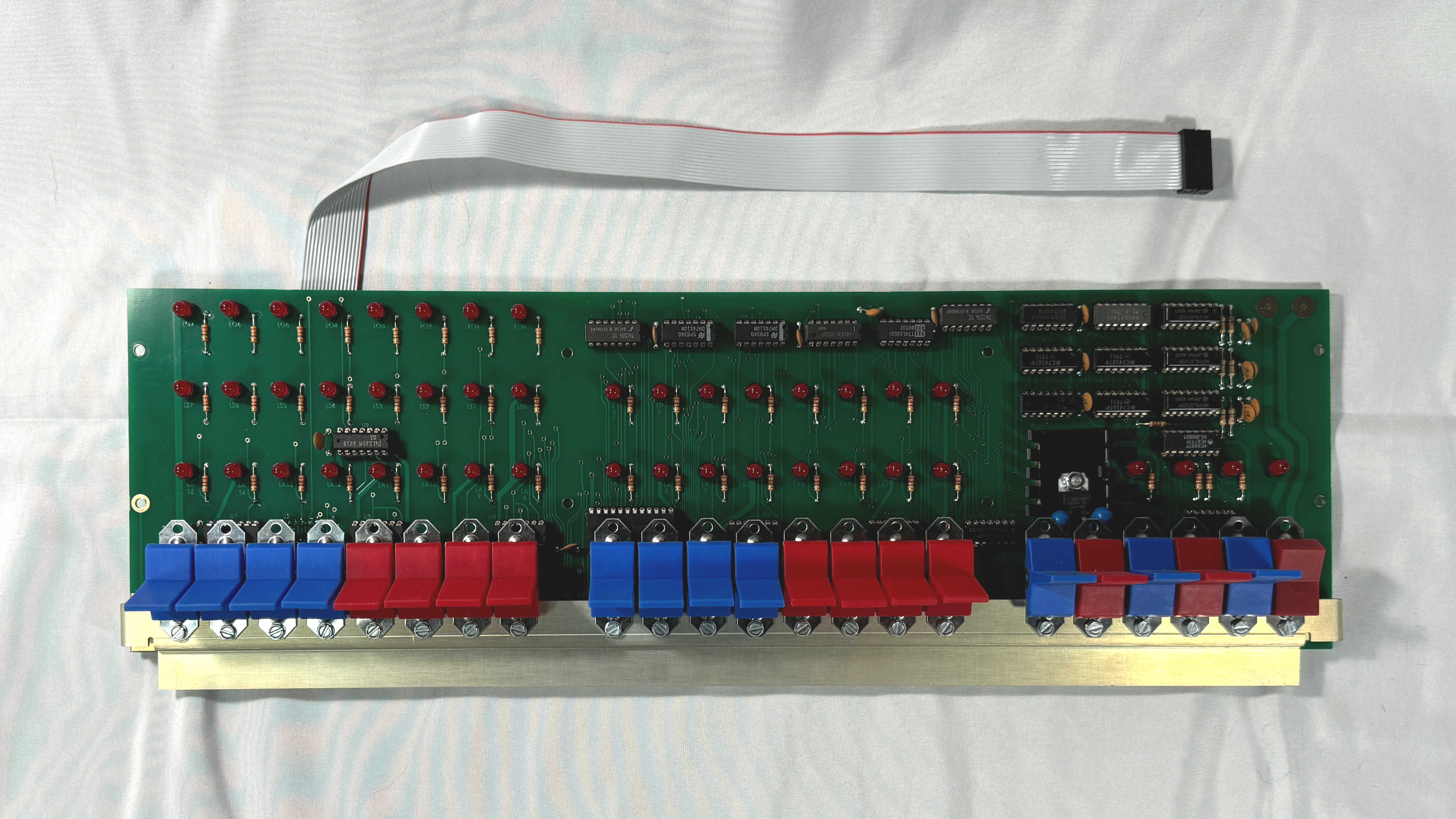
The IMSAI CP-A Rev-4 is a faithful reproduction of the 1975 CP-A front panel (A.K.A. the “operator interface”) by IMS Associates, Inc.
The CP-A is designed to work with the MPU-A board and third-party 8080A microprocessor boards.
Other 8-bit processors such as the 8085 and Z80 will work with reduced functionality.
See Compatibility for details.
The board’s mounting, LED, and switch mounting holes were meticulously measured from a 1975 IMSAI CP-A bare board.
There is a newer version of the CP-A available. Check here for more information.
The vast majority of the parts, including the button head screws and LEDs, are identical to the 1975 originals.
Mechanical parts like the switch bracket and display panel components have been carefully reverse engineered and sourced
to be indistinguishable from the 1975 originals.
The graphics on the front panel are from a precision 2400 DPI scan of an original CP-A photo mask from 1976,
and rendered onto a modern photographic film.
A notable exception to the compatibility with the original are the switches.
Although they are an excellent visual match to the C&K paddle switches originally used, the switch paddles are not interchangeable with C&K nor NKK.
These switches are interchangeable with Alcoswitch and E-Switch.
We suggest you do not mix and match different manufacturers in the same CP-A. There are always color differences.
If different switch models are next to each other, these differences may be noticeable. This is why we offer switchless kits.
If you have switches you like better – maybe they’re all black – maybe you found a stash of new old stock C&Ks – get a switchless kit.
The CP-A Rev-4 is licensed for sale by IMSAI from RetroTechReboot.
It is entirely produced and shipped by Parastream Technologies.
Note that it has been updated to include all IMSAI ECNs and ECOs, so it is no longer necessary to apply those to the board.
When the User Manual is ready, it will be available for download.
Complete Kits
Order one from the list below. The kits are complete with everything you need except solder and tools unless otherwise stated.
They even come with a professionally printed user manual. Be sure to hover over any
 icons for more information.
Most builders won’t need anything else besides one of the above complete kits.
To skip over the options go to More Information to get links to useful resources.
If you're an advanced builder and want to see all the options, read on.
Options
Bare Board
You may order a bare printed circuit board for you to use your own parts.
Be advised that individual parts are not available to bare board customers unless they are explicitly in the parts list below.
IMSAI Parts
If you’re looking for individual IMSAI parts, click one of these links:
Front Panel Assembly Components,
Front Panel Switches.
Generic Parts
The CP-A Rev-4 is compatible with all IMSAI 8080 cabinets and compatible backplanes with the following boards:
- IMSAI MPU-A and compatible 8080A processor boards.
- RAM and DRAM memory boards 64K or less in 8-bit mode.
Other processor boards with a 16-pin DIP cable socket may be compatible with reduced functionality. For example:
- Pressing the STOP switch may not always stop on an M1 cycle.
- The PROGRAMMED INPUT switches may not read correctly from port FF hex.
- The PROGRAMMED OUTPUT LEDs may not function correctly with some Z80 processors.
Processor Board
Compatibility Table
Hover over cells for more information. This table is a work in progress. Blank cells are currently unknown or under investigation.
Values in parenthesis have been determined by inspection of the schematic and not field verified.
| Operation |
IMSAI MPU-A |
IMSAI MPU-B |
Cromemco ZPU |
Ithaca Audio IA-1010 |
Solid State Music CB1/CB2 |
S-100 Computers Z80 |
S-100 Computers Z80 v3 |
TDL ZPU |
Vector Graphics Z80 |
| CPU |
8080 |
8085 |
Z80 |
Z80 |
Z80 |
Z80 |
Z80 |
Z80 |
Z80 |
| Data Bus Cable |
✔ |
✔ |
✔ |
✔ |
✔ |
✖ |
✔ |
✔ |
✔ |
| Run/Stop |
✔ |
2 |
✔ |
✔ |
✔ |
|
(✔) |
✔ |
✔ |
| Max Clock Rate |
2 MHz |
3 MHz |
4 MHz |
|
|
|
|
|
|
|
RESET Stops CP-A 0 |
✔ |
(✔) |
✖ |
|
|
|
|
✔ |
|
|
Stop on M1 1 |
✔ |
✖ |
✔ |
|
|
|
|
✖ |
|
| Examine (Next) |
✔ |
(✔) |
✔ |
|
|
|
|
✔ |
|
| Deposit (Next) |
✔ |
(✔) |
✔ |
|
|
|
|
✔ |
|
| Single Step |
✔ |
(✔) |
✔ |
|
|
|
|
✔ |
|
| Programmed Input |
✔ |
(✔) |
✔ |
|
|
|
|
✔ |
|
| Programmed Output |
✔ |
(✔) |
✔ |
|
|
|
|
✔ |
|
| Drives STACK LED |
✔ |
✖ |
4 |
|
|
|
|
5 |
|
| Drives pINTE and LED |
✔ |
3 |
✖ |
|
|
|
|
✔ |
|
| 0 |
The CP-A relies on the processor board asserting POC* (pin 99) when the RESET switch is raised.
If the processor board doesn't do this (e.g. POC* is according to the IEEE 696 standard),
the CP-A will not stop after reset if it was previously running, nor will it clear the Programmed Output LEDs,
nor explicitly reset the Examine state machine.
|
| 1 |
The Z80 can have up to two M1 cycles for a single instruction.
This means that the CP-A may occasionally stop on the second M1, even if the board implements special hardware to make the CP-A stop on M1.
|
| 2 |
The IMSAI MPU-B uses XRDY2 on pin 12 instead of XRDY on pin 3. A cut and jumper on the MPU-B is necessary to make Run/Stop work. |
| 3 |
The IMSAI MPU-B pulls the pINTE line high with a 1K resistor by default. |
| 4 |
The Cromemco ZPU illuminates the STACK LED when running at 4MHz.
You will notice that when the system is stopped, the STACK LED goes out.
This is because it throttles down to 2MHz for better operation with the CP-A.
|
| 5 |
The TDL ZPU drives the sSTACK bus signal with the Z80 REFRESH line by default. |
Component Sourcing Statement
All components in the CP-A Rev-4 kit are new production with the exception of the 7427, 7430, 74107, 8212, and 8T97 ICs which are new old stock.
The content of the user manual is reproduced from an original CP-A user manual from San Leandro, plus new content.
Engineering Change Orders
There are two sets of change orders that apply to the CP-A Rev-4.
The first is for the Parastream/IMSAI boards, and the second are for the San Leandro boards.
The following ECOs are in effect for the currently shipping CP-A Rev-4 boards and kits:
ECO 24-0001,
ECO 24-0008,
ECO 24-0009,
ECO 24-0010,
ECO 25-0002,
ECO 25-0003
The following ECOs are in effect for the original IMSAI CP-A Rev-4 from San Leandro.
The currently-shipping boards already include these ECNs:
ECO 76-0061,
ECO 77-0035,
ECO 77-0039,
ECO 77-0098
IC Datasheets
The CP-A is designed to work in an original S-100 bus system.
When the IEEE working group were hammering out the S-100 specifications in 1979,
they made a decision not to support some of the very 8080 specific features of the bus in favor of more generic protocols.
This decision severely impacts the way the CP-A operates, and requires several changes to make it work —
or at least not do bad things to the attached processor board.
- Cut the trace going to the bus pin 20.
Turn the board over and follow pin 70 up and a bit to the right, you’ll find a via that’s connected to pin 20.
Cut the trace on the back side to that via and it should cut pin 20 loose without changing anything else.
This pin is attached to the CP-A’s internal tie-high line.
When pin 20 is connected to ground (per the IEEE 696 specification),
it basically disables the CP-A because all of the tie-high logic points are now ground.
The original intent was to have the CP-A hold the UNPROT (pin 20, memory unprotect) line high to keep addressed memory unprotected.
In retrospect, this was never a good idea. This is probably a modification that all CP-A users should do.
- Cut the trace going from bus pin 53 to its via. The IEEE 696 specification connects pin 53 to ground.
This pin is driven low by the CP-A to disconnect the processor board’s data bus from the S-100 DI bus,
which allows the CP-A to jam the programmed input switches onto the data bus.
If bus pin forced to ground, it will permanently connect the switches to the data bus, rendering the processor board inoperable.
The side-effect of this modification is that the programmed input port (FF hex) will always read as FF hex.
- IMSAI systems assume the POC* line also asserts during RESET*. Only the MPU-A and MPU-B drive the POC* this way.
If you have a non-IMSAI CPU board, you’ll need to move pin 99 to pin 75.
On the back side, you can cut pin 99 from its via and jumper over to pin 75.
The sense switch port is decoded from the upper 8 address bits. While this will work with an 8080 and 8085, it doesn’t work on a Z80.
|